Quick start
Environnements
Maia is now distributed in elsA releases (since v5.2.01) !
If you want to try the latest features, we provide ready-to-go environments including Maia and its dependencies on the following clusters:
Spiro-EL8
This is the recommended environment for standalone usage of Maia. It works with intel mpi library (2021) and python version 3.9.
source /scratchm/sonics/dist/source.sh --env maia
module load maia/dev-default
If you want to use Maia within the standard Spiro environment, the next installation is compatible with the socle socle-cfd/5.0-intel2120-impi:
module use --append /scratchm/sonics/usr/modules/
module load maia/dev-dsi-cfd5
Note that this is the environment used by elsA for its production spiro-el8_mpi.
Sator
Similarly, Maia installation are available in both the self maintained and standard socle on Sator cluster. Sator’s version is compiled with support of large integers.
# Versions based on self compiled tools
source /tmp_user/sator/sonics/dist/source.sh --env maia
module load maia/dev-default

# Versions based on socle-cfd compilers and tools
module use --append /tmp_user/sator/sonics/usr/modules/
module load maia/dev-dsi-cfd5
If you prefer to build your own version of Maia, see Installation section.
Supported meshes
Maia supports CGNS meshes from version 4.2, meaning that polyhedral connectivities (NGON_n, NFACE_n
and MIXED nodes) must have the ElementStartOffset node.
Former meshes can be converted with the (sequential) maia_poly_old_to_new script included
in the $PATH once the environment is loaded:
$> maia_poly_old_to_new mesh_file.hdf
The opposite maia_poly_new_to_old script can be used to put back meshes in old conventions, insuring compatibility with legacy tools.
Warning
CGNS databases should respect the SIDS. The most commonly observed non-compliant practices are:
Empty
DataArray_t(of size 0) underFlowSolution_tcontainers.2D shaped (N1,N2)
DataArray_tunderBCData_tcontainers. These arrays should be flat (N1xN2,).Implicit
BCDataSet_tlocation for structured meshes: ifGridLocation_tandPointRange_tof a givenBCDataSet_tdiffers from the parentBC_tnode, theses nodes should be explicitly defined atBCDataSet_tlevel.
Several non-compliant practices can be detected with the cgnscheck utility. Do not hesitate
to check your file if Maia is unable to read it.
Note also that ADF files are not supported; CGNS files should use the HDF binary format. ADF files can
be converted to HDF thanks to cgnsconvert.
Highlights
Tip
Download sample files of this section:
S_twoblocks.cgns,
U_ATB_45.cgns
Daily user-friendly pre & post processing
Maia provides simple Python APIs to easily setup pre or post processing operations: for example, converting a structured tree into an unstructured (NGon) tree is as simple as
from   mpi4py.MPI import COMM_WORLD as comm
import maia

tree_s = maia.io.file_to_dist_tree('S_twoblocks.cgns', comm)
tree_u = maia.algo.dist.convert_s_to_ngon(tree_s, comm)
maia.io.dist_tree_to_file(tree_u, 'U_twoblocks.cgns', comm)
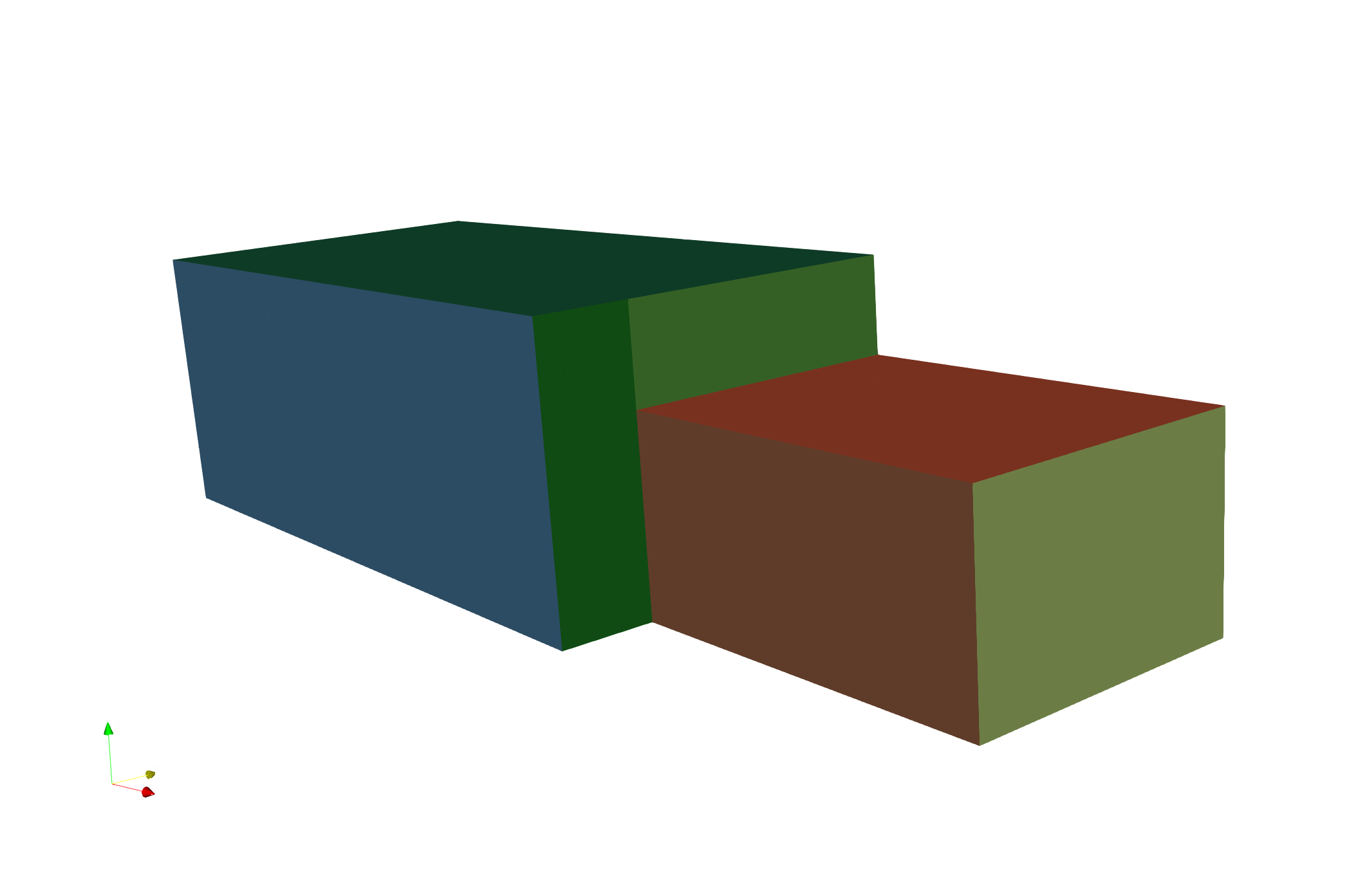
In addition of being parallel, the algorithms are as much as possible topologic, meaning that they do not rely on a geometric tolerance. This also allow us to preserve the boundary groups included in the input mesh (colored on the above picture).
Building efficient workflows
By chaining this elementary blocks, you can build a fully parallel advanced workflow running as a single job and minimizing file usage.
In the following example, we load an angular section of the ATB case, duplicate it to a 180° case, split it, and perform some slices and extractions.
from   mpi4py.MPI import COMM_WORLD as comm
import maia.pytree as PT
import maia

# Read the file. Tree is distributed
dist_tree = maia.io.file_to_dist_tree('U_ATB_45.cgns', comm)

# Duplicate the section to a 180° mesh
# and merge all the blocks into one
opposite_jns = [['Base/bump_45/ZoneGridConnectivity/matchA'],
                ['Base/bump_45/ZoneGridConnectivity/matchB']]
maia.algo.dist.duplicate_from_periodic_jns(dist_tree,
    ['Base/bump_45'], opposite_jns, 22, comm)
maia.algo.dist.merge_connected_zones(dist_tree, comm)

# Split the mesh to have a partitioned tree
part_tree = maia.factory.partition_dist_tree(dist_tree, comm)

# Now we can call some partitioned algorithms
maia.algo.part.compute_wall_distance(part_tree, comm,
    families=['WALL'], point_cloud='Vertex')
extract_tree = maia.algo.part.extract_part_from_bc_name(part_tree, "wall", comm)
slice_tree = maia.algo.part.plane_slice(part_tree, [0,0,1,0], comm,
      containers_name=['WallDistance'])

# Merge extractions in a same tree in order to save it
base = PT.get_child_from_label(slice_tree, 'CGNSBase_t')
PT.set_name(base, f'PlaneSlice')
PT.add_child(extract_tree, base)
maia.algo.pe_to_nface(dist_tree,comm)

extract_tree_dist = maia.factory.recover_dist_tree(extract_tree, comm)
maia.io.dist_tree_to_file(extract_tree_dist, 'ATB_extract.cgns', comm)
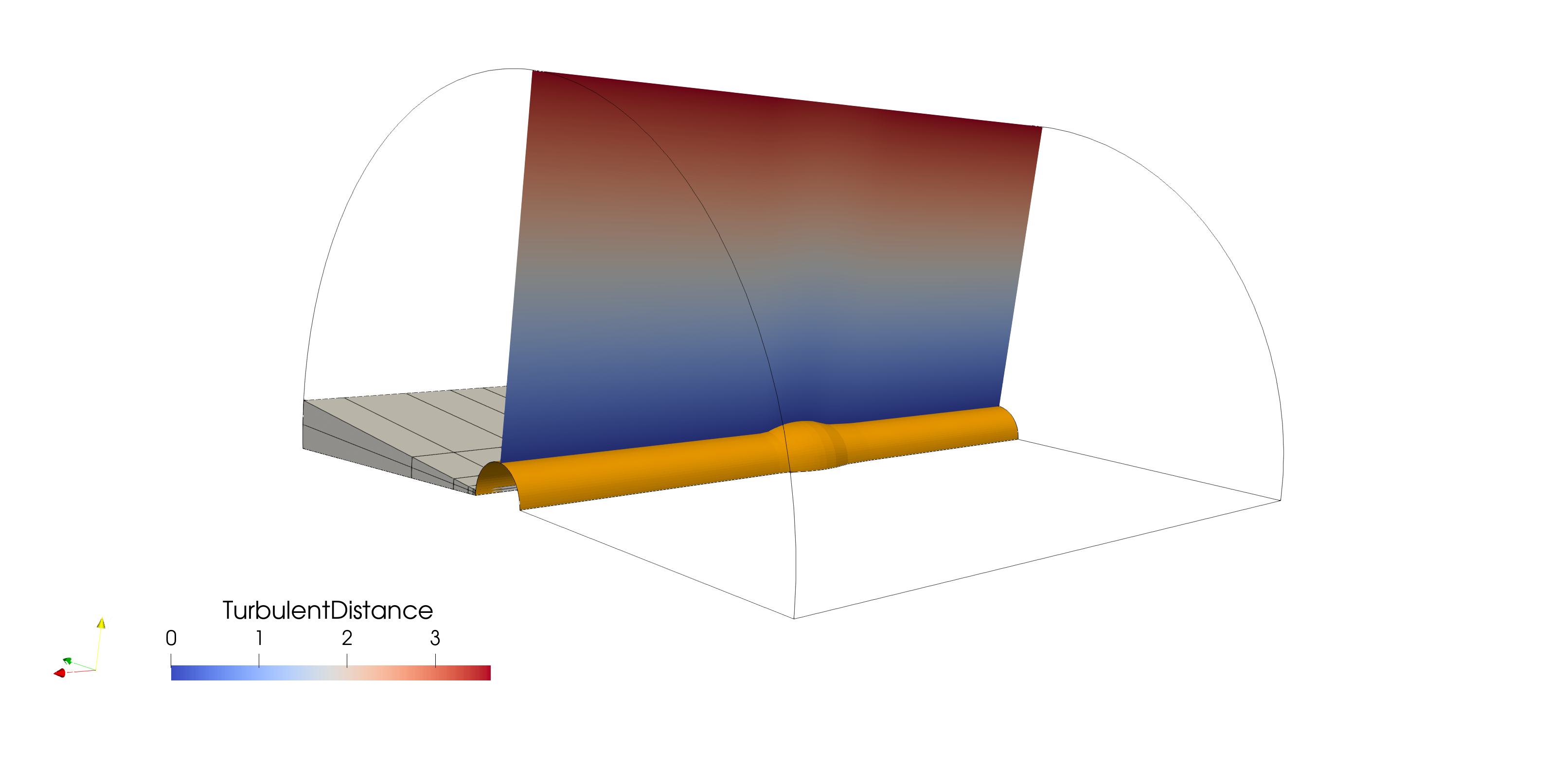
The above illustration represents the input mesh (gray volumic block) and the extracted surfacic tree (plane slice and extracted wall BC). Curved lines are the outline of the volumic mesh after duplication.
Compliant with the pyCGNS world
Finally, since Maia uses the standard CGNS/Python mapping, you can set up applications involving multiple python packages: here, we create and split a mesh with maia, but we then call Cassiopee functions to compute the gradient of a field on each partition.
from   mpi4py.MPI import COMM_WORLD as comm
import maia
import Transform.PyTree as CTransform
import Converter.PyTree as CConverter
import Post.PyTree      as CPost

dist_tree = maia.factory.generate_dist_block([101,6,6], 'TETRA_4', comm)
CTransform._scale(dist_tree, [5,1,1], X=(0,0,0))
part_tree = maia.factory.partition_dist_tree(dist_tree, comm)

CConverter._initVars(part_tree, '{Field}=sin({nodes:CoordinateX})')
part_tree = CPost.computeGrad(part_tree, 'Field')

maia.transfer.part_tree_to_dist_tree_all(dist_tree, part_tree, comm)
maia.io.dist_tree_to_file(dist_tree, 'out.cgns', comm)
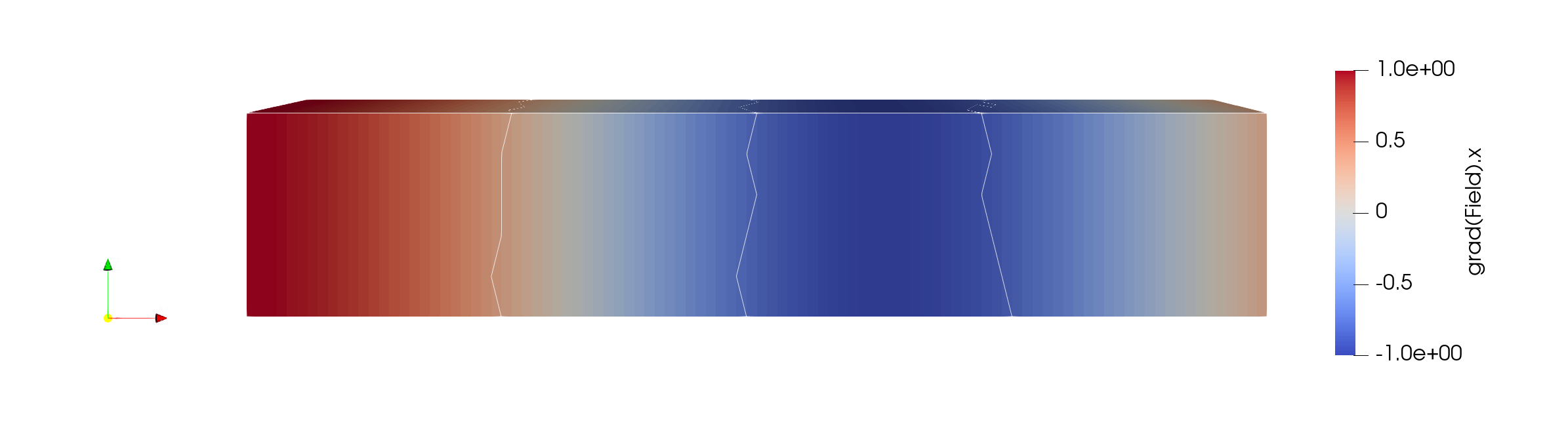
Be aware that other tools often expect to receive geometrically consistent data, which is why we send the partitioned tree to Cassiopee functions. The outline of this partitions (using 4 processes) are materialized by the white lines on the above figure.
Resources and Troubleshouting
The user manual describes most of the high level APIs provided by Maia. If you want to be comfortable with the underlying concepts of distributed and partitioned trees, have a look at the introduction section.
The user manual is illustrated with basic examples. Additional test cases can be found in the sources.
Issues can be reported on the gitlab board and help can also be asked on the dedicated Element room.